Wednesday, July 2, 2008

Animism is a belief...?

More and more everyday, I feel convinced that animism is not a belief or belief system.

Rather, it is a form of experience that springs from being present in and with the natural world. If I say to you that yesterday I felt the trees watching me, and could feel their warm care surround me as I walked slowly through the forest you might be inclined to think I was being poetic. If I told you the story of the time a raven flew in front of my mom's old jeep and told me in no uncertain terms that the car was going to break down and that we were in danger, you might think that was weird and even fantastic. The car did break down very shortly afterwards, and because of the warning I was watching out for it and therefore kept my family safe.

Do I experience the natural world that I am part of in this way, because I believe that it is aware and can communicate with us? I do not think so.

Let's stop and consider some definitions for a moment...

According to dictionary.com, animism is defined as:

1)the belief that natural objects, natural phenomena, and the universe itself possess souls.

2)the belief that natural objects have souls that may exist apart from their material bodies.

3)belief in spiritual beings or agencies.

The first two definitions show a strong bias by the Judeo-Christian world view. Generally, peoples around the world who see the world from the animist perspective would not say that the universe and the things or beings in it have "souls." The concept of a soul is generally viewed as an entity or essence separate from the body. It is the Western world view which separates the world into parts and bits, like pieces of a machine.

Tribal cultures don't see the universe or nature or human beings as machines, rather they seem them as vital with life. They see life itself as a energy full of awareness. In Hawai'i for instance, Pele' is not the "spirit of the lava" rather, she IS the lava. There is no separation between her and the lava. It is not a possession for her, it is rather one form she manifests in. It is the western conceptualization that separates essence from form.

All things considered, I think it is our conviction as westerners that the natural world can not possibly be aware and responsive that keeps us from experiencing it as such.

The 3rd definition of animism also has interesting implications. People in many tribal cultures have regular, often daily, interactions with what in our culture we might call "spirits." If you asked those same people - say for example people from the heart of the amazon such as the Shuar or from a tribe in Papua New Guinea whether they believed in these spirits, they would look at your like you were crazy or stupid. Using the faculty of belief is not necessary for them to speak with the natural world and all the beings that make up that world. They simply do it. Tribal peoples have an equal need to speak with the natural forces and entities around them as we have a need to speak with other human beings in our communities, be they large or small.

I'd like to try a little exercise in awareness. I don't know what the results will be, but give it a try and let me know.

Play along with me for a moment... pretend for this little instant in time that you are not certain that the world is already predictable, pretend (although you might be sure you know better) that nature and everything in it is not dumb and mechanical, play along with me now and drop the assumptions you have that when you know the name of something you can ignore it as unimportant. If you already see it otherwise great, if not just humor me for a moment. Consider this a fun little meditation, if you like.

Now...

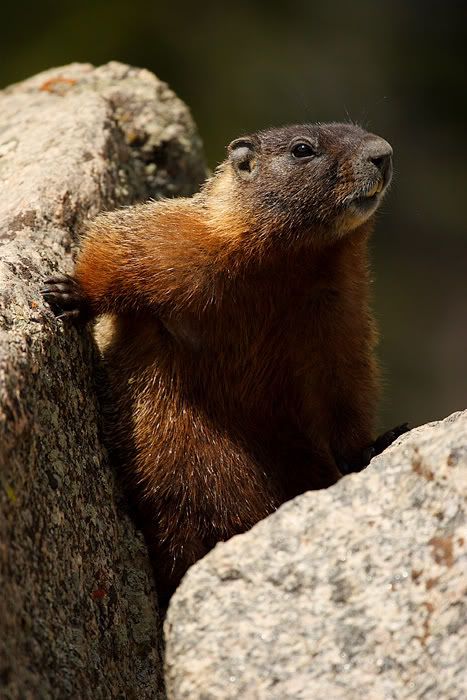
Look into the eyes of this animal. Imagine yourself being were I was when I took this picture, hanging out on a rocky cliff side above the Lamar River. Notice how it considers you with its eyes.

Set aside your preconceived notions and just look. Enjoy the quiet exchange. That is where the animist experience blossoms from.

Friday, June 20, 2008

The World Transformed


A little more on the animistic vision of the world...

For those of us who were not born into an animistic culture, often what awakens us to this perspective are world-shifting experiences. Those experiences are as individual as each of us, but there are certain threads of consistency and similarity that can be found in all of them.

Daniel Quinn shares just such an experience in his book Providence.

I went last, stepped over the threshold, turned around to close the door, then turned back to face the sunshine.

And the god spoke.

I put it this way. I could put it other ways. I could say that, when I turned to face the sunshine, the veil that clouds our vision was gone from my eyes, and for the first time I saw the world as it is.

There are no words for it.

Someone blind from birth can't imagine what the sighted mean by color, can't fathom what this property might be. If all language were the product of a blind race, the word color would not exist, and if one of that blind race were suddenly to become sighted, he would be unable to describe what he saw; the words would simply not be there for him to use, and this is the way it is for me: The words are simply not there.

But I can put it other ways, and I will, because that's what I can do.

I turned and faced the sunshine, and the breath went out of me as if someone had punched me in the stomach. That was the effect of receiving this sight, of seeing the world as it is. I was astounded, bowled over, dumbfounded.

I could say that the world was transformed before my eyes, but that wasn't it--and I knew that that wasn't it. The world hadn't been transformed at all; I was simply being allowed to see it the way it is all the time. I, not the world, had been transformed.

I'm trying. Be patient. We've reached the single most important hour of my life, and I have to get it right, have to come as close as I can to getting it right.

I gasped, literally gasped. I lost my breath, seeing that.

Everything was on fire.

I can say it that way, but when you say that something's on fire, you think of the fire as being on it,--as a substance that is on the thing.

That wasn't it.

Everything was burning. Yes, that's better. From within, everything was burning.

Every blade of grass, every single leaf of every single tree was radiant, was blazing--incandescent with a raging power that was unmistakably divine.

I was overwhelmed. In a single second of this, of seeing this truth, tears flooded my eyes and poured down my face as I walked along behind the novices. It was strange to see fence posts sitting dead and silent and cold in the midst of this tremendous, thrumming effulgence.

In this vast, scintillating landscape, my nearsightedness was of no account at all. For as far as I could see, for hundreds of yards, thousands of yards, I could distinguish with absolute clarity each leaf, each blade of grass--no two alike anywhere. Each was crackling and trembling and all but exploding with the raging power that animated it.

Again I describe that power as raging. Look into a furnace blazing at its top capacity. Look into the heart of a nuclear reaction perhaps. The power that I saw thundering around me makes all our stock images of power seem feeble. But there was no violence or hatred in this rage. This was a rage of joy, of exuberance. This was creation's everlasting, silent hallelujah.

You know the sparklers they sell around July 4th. The world was ablaze with sparklers. Every blade of grass, every leaf of every tree wascharged with energy--packed, jammed, evanescent with energy, which radiated forth into the air irresistability. The whole landscape pulsed, breathed, moved, was made iridescent with this energy. I think, with what can be done in film today, I could produce a cinematic approximation of what I saw. It would be magnificent, but you would of course know it was just a trick. What I was seeing was reality, was the world as it actually is, every moment of every day....

No, no, I wasn't in a trance. I wasn't in anything remotely like a trance. I was gathering kindling, for God's sake! I had trailed the novices for awhile, walking through the madly radiant land, then had been signed[The novices only used sign language] to head off into the brush to get started. So there I was, stooping and picking up sticks, and breaking them across my knee or leaning them up against a rock to stamp them into smaller lengths, and making pile that would later be loaded into a cart, and all the while tears were pouring down my cheeks like a waterfall. I was lucky I was working alone, though I don't think I would have felt the least self-conscious about my tears if there had been dozens around me. Who could have cared? Certainly not me.

It lasted for about an hour. The radiance just faded away, gradually subsided, and the world resumed its normal appearance. The rest of the crew came along, and we loaded up the kindling and headed back.


Sunday, May 18, 2008

The Supernatural

All of the quotes below are from the same source, David Abram's SPELL OF THE SENSUOUS.

The primacy for the magician of nonhuman nature - the centrality of his relation to other species and to the earth - is not always evident to Western researchers. Countless anthropologists have managed to overlook the ecological dimension of the shaman's craft, while writing at great length of the shaman's rapport with "supernatural" entities. We can attribute much of this oversight to the modern, civilized assumption that the natural world is largely determinate and mechanical, and that that which is regarded as mysterious, powerful, and beyond human ken must therefore be of some other, nonphysical realmn above nature, "supernatral."


Our modern ideas about the realm of the spirits being some how separate from nature, are actually relatively recent ideas in history. They stem from our largely Judeo-Christian perspective, in which heaven is a realm above and separate from nature. Such an uncoupling is not observed in most oral cultures.

Nevertheless, that which is regarded with the greatest awe and wonder by indigenous, oral cultures is, I suggest, none other than what we view as nature itself. The deeply mysterious powers and entities with whom the shaman enters into a rapport are ultimately the same forces - the same plants, animals, forests, and winds - that to the literate, "civilized" Europeans are just so much scenery, the pleasant backdrop of our more pressing human concerns.


When indigenous people talk about the land being alive and aware, they are not using metaphor. To them it is alive and aware. That has been true in my own experiences.

Magic, then, in its perhaps most primordial sense, is the experience of existing in a world made up of multiple intelligences, the intuition that every form one perceives - from the swallow swooping overhead to the fly on a blade of grass, and indeed the blade of grass itself - is a experiencing form, an entity with its own predilections and sensations, albeit sensations that are very different from our own.


The Matrix

I'm writing out some quotes from The Matrix Trilogy and also some thoughts about the ideas shared in the movies and why they might be significant and/or useful to expanding our awareness of life and reality.


Morpheus: I imagine you that right now you're feeling a bit like Alice, tumbling down the rabbit hole?

Neo: You could say that.

Morpheus: I can see it in your eyes. You have the look of a man who accepts what he sees because he is expecting to wake up. Ironically, this is not far from the truth. Do you believe in fate, Neo?

Neo: No.

Morpheus: Why not?

Neo: Because I don't like the idea that I am not in control of my life.

Morpheus: I know exactly what you mean. Let me tell you why your here. Your here because you know something. What you know you can't explain, but you feel it. You felt it your entire life. That there is something wrong with the world, you don't know what it is, but its there. Like a splinter in your mind, driving you mad. It is this feeling that has brought you to me. Do you know what I am talking about?

Neo: The Matrix?

Morpheus: Do you want to know what it is?

Neo:*nods*

Morpheus: The Matrix is everywhere. It is all around us. Even now in this very room. You can see it when you look out your window, or turn on your television. You can feel it when you go to work, when you go to church, when you pay your taxes. It is the world which has been pulled over your eyes to blind you from the truth.

Neo: What truth?

Morpheus: That you are a slave, Neo. Like everyone else, you were born into bondage. Born into a prison that you can not smell, or taste, or touch. A prison, for your mind.

Unfortunately, no one can be told what the Matrix is...you have to see it for yourself.


This is of course part of one of the most famous scenes in cinematic history... The scene with the blue pill and the red pill.

CHOICE.

It is that seemingly insignificant little thing that Life presents us with when we seek to know the truth.

The other key aspect of this scene is PERSPECTIVE.

There are of course countless ways to interpret this set of scenes from the Matrix. The way I understand it is that it is addressing the fundamental dilemma posed by enlightenment. That is, posed by a moment of world-shattering personal revelation the likes of which we are not likely to recover from again.

The world we tell ourselves about is an illusion... an illusion held up by our thoughts. When we have an experience of seeing life - not as what we think it is but instead seeing WHAT IS - our thoughts stop. They pale and shrivel under the power of that magnificence. It is unfortunate that our culture tends to view individuals who have had such experiences as mad or even as dangerous. Seeing outside of the shell of experience drawn out by our civilization is seen as sheer madness, but it may also be something we need now more than ever in our history.

Morpheus: As long as the Matrix exists, the human race will never be free.


The way I have come to understand it, the Matrix is the thing we take so for granted, the thing that shapes the way we see everything in such a way that we are blind to the fog it puts before our eyes and deaf to what it constantly whispers in our ears. It is the great experiment that we call civilization.

Daniel Quinn, author of ISHMAEL, BEYOND CIVILIZATION and other titles has a name that encapsulates all the peoples that are part of this experiment. He calls them TAKERS.

It's easy to pick out the people who belong to "our" culture. If you go somewhere--anywhere in the world--where the food is under lock and key, you'll know you're among the people of our culture. They may differ wildly in relatively superficial matters--in the way they dress, in their marriage customs, in the holidays they observe, and so on. But when it comes to the most fundamental thing of all, getting the food they need to stay alive, they're all alike. In these places, the food is all owned by someone, and if you want some, you'll have to buy it. This is expected in these places; the people of our culture know no other way.

Making food a commodity to be owned was one of the great innovations of our culture. No other culture in history has ever put food under lock and key--and putting it there is the cornerstone of our economy, for if the food wasn't under lock and key, who would work?- from Beyond Civilization, pg. 5


There are also those people who do NOT belong to the TAKERS. Quinn gives them the name LEAVERS. Leavers are the indigenous peoples of the world, the people also known as "primitive" or "tribal." The Leavers take what they need from the world and leave the rest alone. Living in this manner, Leavers thrive in times of abundance and dwindle in times of scarcity. The Takers however, practicing their unique form of agriculture (which Quinn calls, Totalitarian Agriculture) produce enormous food surpluses, which allows them to thwart the gods when they decide it's the Takers' time to go hungry.

The Taker perspective on life is them against the world. That is why so much in our civilization is focused on conquering: everything from climbing mountains, building dams, to producing food and maintaining health.

So where does such an attitude come from in the Takers? Why do they view themselves as separate from nature? I think the following quote from Alberto Villoldo's DANCE OF THE FOUR WINDS book captures it very well...

"The Western world, the civilized nations, what is called the 'first world' cultures, rule the Earth by right of their economic and military might. And the philosophical foundation of the Western culture is based on a religion that teaches of the fall from grace, original sin, and the exodus from the Garden of Eden. This concept is fundamental to the mythology of the West, and represents Nature as hostile and man as corrupt.

...

"It is such a peculiar myth," Morales said, "The emphasis is not man's relationship to his environment, to Nature, to the Garden, but man's relationship to himself as an outcast, fending for himself, becoming self-conscious in a hostile world. The Westerner has accepted this tradition, has promoted this concept through art and literature and philosophy. Indeed, it has become ingrained and second nature, has it not?"

"I suppose it has," I said. "You can live your entire life in a city, for instance. It provides shelter, a controlled environment, and acts as a buffer between the individual and Nature. Even foods in supermarkets are treated before they are consumed, either artificially ripened, colored, or preserved, then packaged for consumption."


One of the basic assumptions in Taker culture is that we are separate from nature. It is a perspective of "Man and Nature" rather than "Nature includes Man." It might sound like a unimportant opinion about the human relationship to nature, but this view has devastating consequences. It allows us as Takers to act with absolute conviction that we are at odds with it, therefore, devastating the earth and sending countless species of to extinction without regret or remorse. Why should we? We are separate from those extinctions, separate from nature, so it won't effect us, right? This perspective allows us not only to feel that what we do as Takers is understandable, but also that it is necessary.

Friday, May 16, 2008

For the shaman, life is not limited to plants, animals, and humans, because life is defined as movement. Some things move very slowly, like rocks, and some things move very quickly, like light. For a shaman these are simply different kinds of life.

- Serge Kahili King

Thursday, May 15, 2008

A Silent Exchange

Consider a spider weaving its web, for instance, and the assumption still held by many scientists that the behavior of such a diminutive creature is thoroughly "programmed in its genes." Certainly, the spider has received a rich genetic inheritance from its parents and its predecessors. Whatever "instructions," however, are enfolded within the living genome, they can hardly predict the specifics of the micro-terrain within which the spider may find itself at any particular moment. They could hardly have determined in advance the exact distance between the cave wall and the branch that the spider is now employing as an anchorage point for her current web, or the exact strength of the monsoon rains that make web-spinning a bit more difficult on this evening. And so the genome could not explicity have commanded the order of every flexion and extension of her various limbs as she weaves this web into its place. However complex are the inherited "programs," patterns, or predispositions, they must still be adapted to the immediate situation in which the spider finds itself. However determinate one's genetic inheritence, it must still, as it were, be woven into the present, an activity that necessarily involves both a receptivity to the specific shapes and textures of that present and a spontaneous creativity in adjusting oneself (and one's inheritance) to those contours. It is this open activity, this dynamic blend of receptivity and creativity by which ever animate organism necessarily orients itself to the world (and orients the world around itself), that we speak of by the term "perception."

- David Abram, SPELL OF THE SENSUOUS


In our culture, we tend to view nature as largely mechanistic in its actions. Even when evidence for the contrary looks us right in the eye.

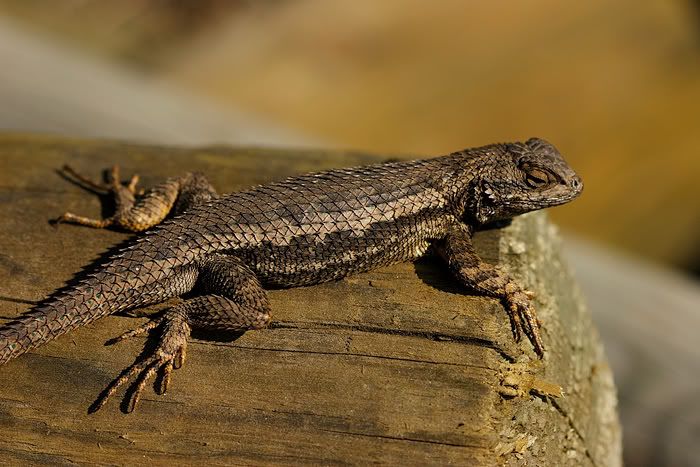
When in California last Spring, I was exploring a restored salt marsh known as Bolsa Chica. Along a trail through the drier uplands, I spotted a western fence lizard in the leaf litter below some shrubs. With my camera, I squatted down to get a closer look. Fully expecting it to run off, the lizard did something very unexpected. It ran a little closer to me and snatched a bug, which it crunched down and swallowed quickly. With that, I sat down and started shooting pictures. The lizard posed, without fear. Then, it ran up to me in several spurts and hid under one of my crossed legs. From their it hopped onto my jeans and climbed up my leg into my lap, and stopped to look me deep in the eyes. There was a wordless exchange passed between us. I felt a strong feeling of acceptance, peace and even friendly warmth flowing from this lizard. For a moment, I felt I had a peak into the deep awareness that is "lizard." That very same lizard is in the photo below.


Such an experience may be passed off as a fluke of nature. An odd event that was a coincidence. Nothing more. I have had too many such "coincidences" in my life to believe that, though.

Intermittently, I began to wonder if my culture's assumptions regarding the lack of awareness in other animals and in the land itself was less a product of careful and judicious reasoning than of a strange inability to clearly see, or focus upon, anything outside the realm of human technology, or to hear as meaningful anything other than human speech.

- David Abram, SPELL OF THE SENSUOUS


It is a common western cultural assumption, that animals are less intelligent, less aware beings. Their ability to comprehend their experience in life limited by the development and size of their brains. And if they show themselves to act outside of the mostly mechanical assumptions, we excuse them to be motivated only by their basic functions, such as "Oh, that lizard was just looking for food, some bugs on your clothes." It is as if until the animals walk up to us and start speaking English, we won't believe that communication with them is possible. We won't believe that they can be just as aware of their world as we are, but in a different way.

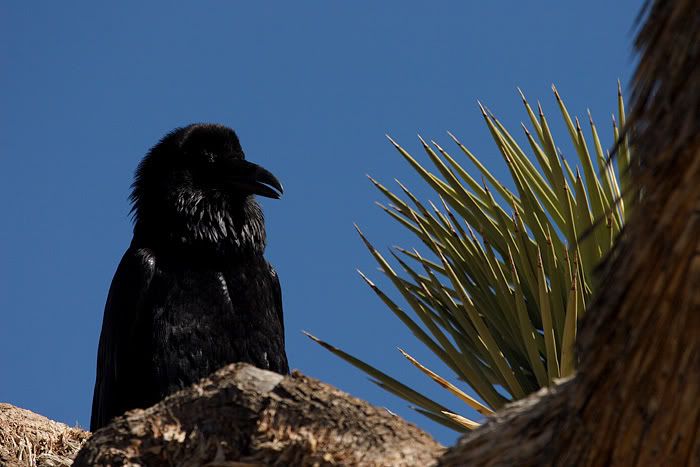
Another event happened this past year with a raven in the desert of Joshua Tree National Park. A raven landed in a nearby joshua tree as I was walking back towards our car, along the trail. I approached it slowly, hoping for some close up photos. The bird started calling, in a low, soft voice. Soft, that is, for a raven. It would bow its head down and give a soft croak. I imitated this call as best I could, as I had a strange feeling it was aiming this call at me. Then we engaged in calling back and forth for several minutes, in which time I walked slowly closer and closer to the joshua tree it was perched in. Eventually, I was standing almost right under the tree and still the raven was calling. Its the same bird pictured calling in the photo below.


It flew out of the tree as another bird - probably its mate - came flying by. I believed that to be the end of it. But, once I had walked back to the car something else happened. The raven flew by, close to the windshield and looked in, right into my eyes as it passed.

These two very different animals engaged me in cross-species communication. Animals are not the only beings in nature that can communicate with us.

Tuesday, May 13, 2008

Together


Rain is falling on the grass. Individual drops, dreaming their dreams together with their many brothers and sisters. Dropping. Falling. Joining together. Falling on the backs of little birds, and rolling off. Falling into the grass and soil below. Caressing and feeding each in turn. Still falling. Making little puddles. Joining and making little streamlets, streams, rivers, and seas. Oceans. Aren't oceans the dreaming of rain drops?